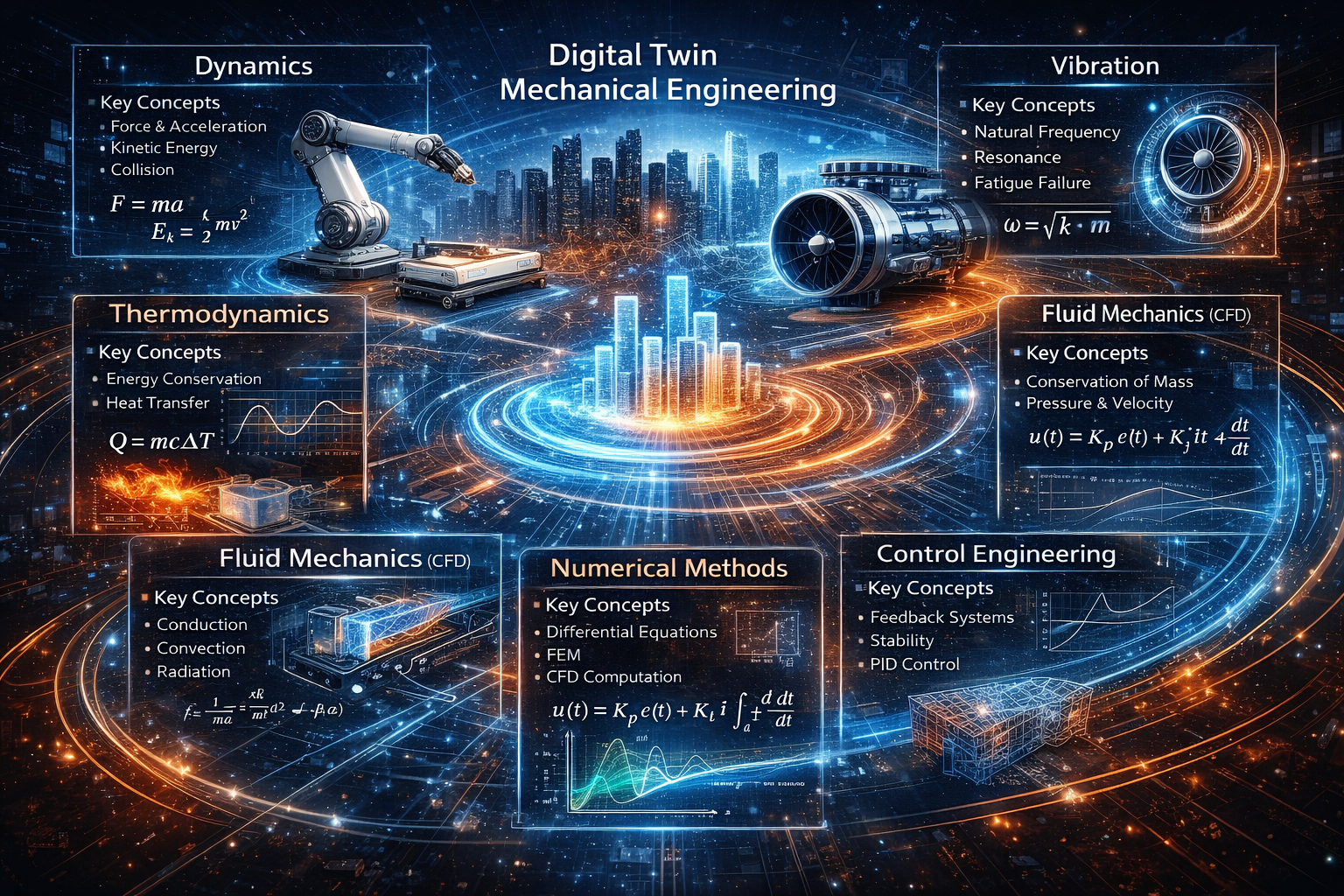
디지털 트윈은 단순한 IT 기술이 아니다.
현실 세계의 물리 시스템을 그대로 복제하고, 예측하고, 최적화하는 기술이다.
그렇다면 핵심은 명확하다.
“현실을 얼마나 정확하게 이해하고, 수식으로 표현할 수 있는가?”
이 글에서는 디지털 트윈 구현에 꼭 필요한 기계공학 핵심 과목과 주요 이론/공식만 실무 기준으로 압축 정리한다.
1. 동역학 (Dynamics) — 모든 움직임의 출발점
디지털 트윈에서 가장 먼저 필요한 것은 “움직임”을 이해하는 것이다.
- OHT 이동
- 로봇 팔 동작
- 설비 가속/감속
이 모든 것은 동역학으로 설명된다.
핵심 개념
- 힘과 가속도의 관계
- 운동 에너지
- 충돌 해석
핵심 공식
F = ma
→ 힘이 어떻게 움직임을 만드는지 설명하는 가장 기본적인 공식
E_k = \frac{1}{2}mv^2
→ 속도 변화와 충돌 영향 분석의 핵심
실무 활용
- 충돌 예측
- 가속/감속 최적화
- 경로 설계
2. 진동/구조역학 — 고장 예측의 핵심
기계는 멈춰 있어도 내부에서는 항상 진동한다.
이 진동이 바로 “고장의 신호”다.
핵심 개념
- 고유진동수
- 공진
- 피로 파괴
핵심 공식

→ 특정 조건에서 진동이 급격히 커지는 현상(공진)을 설명
실무 활용
- 베어링 이상 감지
- 설비 수명 예측
- 구조 안정성 분석
3. 열역학 — 안정성과 효율의 기준
온도는 모든 시스템 성능에 직접적인 영향을 준다.
- 반도체 장비
- 배터리
- 전력 시스템
핵심 개념
- 에너지 보존
- 열전달 (전도, 대류, 복사)
핵심 공식

→ 온도 변화와 열량 관계를 계산
실무 활용
- 과열 방지
- 냉각 시스템 설계
- 에너지 효율 개선
4. 유체역학 (CFD) — 보이지 않는 흐름 제어
눈에 보이지 않지만 성능을 좌우하는 것이 바로 “유체 흐름”이다.
- 공기 흐름 (클린룸)
- 가스 흐름 (반도체 공정)
- 냉각수 흐름
핵심 개념
- 유량 보존
- 압력과 속도의 관계
핵심 공식

→ 유체 흐름의 기본 원리
실무 활용
- 공정 안정성 확보
- 오염 제어
- 냉각 효율 개선
5. 제어공학 — 자동 최적화의 핵심
디지털 트윈의 최종 목적은 단순 분석이 아니라 “자동 제어”다.
핵심 개념
- 피드백 시스템
- 안정성
- 오차 최소화
핵심 공식

→ PID 제어 공식 (가장 널리 쓰이는 제어 방식)
실무 활용
- OHT 속도 제어
- 자동화 설비 안정화
- 실시간 최적화
6. 수치해석 — 디지털 트윈의 계산 엔진
현실의 물리 문제는 대부분 복잡한 미분방정식이다.
이걸 컴퓨터가 풀 수 있게 만드는 것이 수치해석이다.
핵심 개념
- 미분방정식 근사 해석
- FEM (유한요소법)
- CFD 계산
실무 활용
- 구조 해석
- 열 해석
- 유동 해석
핵심 요약 (실무 기준)
디지털 트윈에서 정말 중요한 것은 다음 5가지다.
- 동역학 → 움직임과 충돌
- 진동 → 이상 감지
- 열역학 → 안정성
- 유체역학 → 흐름
- 제어공학 → 자동 최적화
그리고 수치해석은 이 모든 것을 계산하는 “엔진” 역할을 한다.
실무 관점에서의 우선순위 (중요)
특히 반도체 물류(OHT) 기준으로 보면:
1️⃣ 동역학
2️⃣ 제어공학
3️⃣ 진동
이 3가지만 제대로 이해해도
디지털 트윈 핵심 기능의 대부분을 구현할 수 있다.
결론
디지털 트윈의 경쟁력은 화려한 기술이 아니다.
물리 시스템을 얼마나 정확하게 이해하고,
그것을 수식으로 표현할 수 있는가
여기에 달려 있다.
결국 디지털 트윈은
기계공학의 깊이가 그대로 드러나는 기술이다.
Key Engineering Courses & Essential Theories for Digital Twin Implementation
A digital twin is not just an IT technology.
It is a technology that replicates real-world physical systems, predicts their behavior, and optimizes their performance.
So the core question becomes clear:
“How accurately can you understand reality and express it mathematically?”
In this article, we will summarize only the most essential mechanical engineering subjects and key theories/formulas required to implement a digital twin, based on practical relevance.
1. Dynamics — The Foundation of All Motion
The first thing a digital twin must understand is motion.
- OHT movement
- Robotic arm operation
- Equipment acceleration and deceleration
All of these are governed by dynamics.
Key Concepts
- Relationship between force and acceleration
- Kinetic energy
- Collision analysis
Key Equations
F = ma
→ The most fundamental equation describing how force creates motion
Eₖ = ½mv²
→ Essential for analyzing velocity changes and collision impact
Practical Applications
- Collision prediction
- Acceleration/deceleration optimization
- Path planning
2. Vibration & Structural Mechanics — The Core of Failure Prediction
Even when a machine appears stationary, it is constantly vibrating internally.
This vibration is often the first signal of failure.
Key Concepts
- Natural frequency
- Resonance
- Fatigue failure
Key Equation
ω = √(k/m)
→ Explains resonance, where vibration rapidly increases under certain conditions
Practical Applications
- Bearing fault detection
- Equipment lifetime prediction
- Structural stability analysis
3. Thermodynamics — Stability and Efficiency
Temperature directly impacts system performance.
- Semiconductor equipment
- Batteries
- Power systems
Key Concepts
- Energy conservation
- Heat transfer (conduction, convection, radiation)
Key Equation
Q = mcΔT
→ Calculates the relationship between heat and temperature change
Practical Applications
- Overheating prevention
- Cooling system design
- Energy efficiency improvement
4. Fluid Mechanics (CFD) — Controlling Invisible Flows
Fluid flow is often invisible, but it critically affects performance.
- Airflow (cleanrooms)
- Gas flow (semiconductor processes)
- Cooling fluid flow
Key Concepts
- Conservation of mass (continuity)
- Relationship between pressure and velocity
Key Equation
A₁v₁ = A₂v₂
→ Fundamental principle of fluid flow
Practical Applications
- Process stability
- Contamination control
- Cooling efficiency optimization
5. Control Engineering — The Core of Automation
The ultimate goal of a digital twin is not just analysis, but automatic control.
Key Concepts
- Feedback systems
- Stability
- Error minimization
Key Equation

→ PID control equation (the most widely used control method)
Practical Applications
- OHT speed control
- Stabilization of automated systems
- Real-time optimization
6. Numerical Methods — The Computational Engine of Digital Twins
Most real-world physical problems are described by complex differential equations.
Numerical methods make these problems solvable by computers.
Key Concepts
- Approximation of differential equations
- FEM (Finite Element Method)
- CFD computation
Practical Applications
- Structural analysis
- Thermal analysis
- Flow simulation
Key Summary (Practical Perspective)
The most important elements in a digital twin are:
- Dynamics → Motion & collision
- Vibration → Fault detection
- Thermodynamics → Stability
- Fluid mechanics → Flow
- Control engineering → Automation
And numerical methods serve as the engine that computes all of these.
Practical Priority (Important)
For semiconductor logistics (OHT systems), the priority is:
1️⃣ Dynamics
2️⃣ Control engineering
3️⃣ Vibration
Mastering these three alone enables implementation of most core digital twin functionalities.
Conclusion
The true competitiveness of a digital twin does not lie in flashy technology.
It lies in how accurately you understand physical systems
and express them through mathematical models
In the end, a digital twin is a technology where
the depth of mechanical engineering knowledge is fully revealed.
'T — Tech & Trends' 카테고리의 다른 글
| [digital twin-4] 디지털 트윈은 어디에 쓰일까? 제조·항공·반도체 실제 사례 총정리 (0) | 2026.03.23 |
|---|---|
| [digital twin-3] 디지털 트윈 시스템 구조 완전 해부: 센서부터 시뮬레이션까지 (0) | 2026.03.22 |
| [digital twin-1] 디지털 트윈이 뭐길래? 기계공학이 바꾸는 ‘가상 설계’의 시대 (0) | 2026.03.21 |
| 🛡️ Why Defense Projects Are the Most Complex Engineering Programs (0) | 2026.03.16 |
| 세계의 인기 놀이기구와 최신 기술 소개 (Popular Rides and Advanced Technology) (3) | 2024.11.14 |


댓글