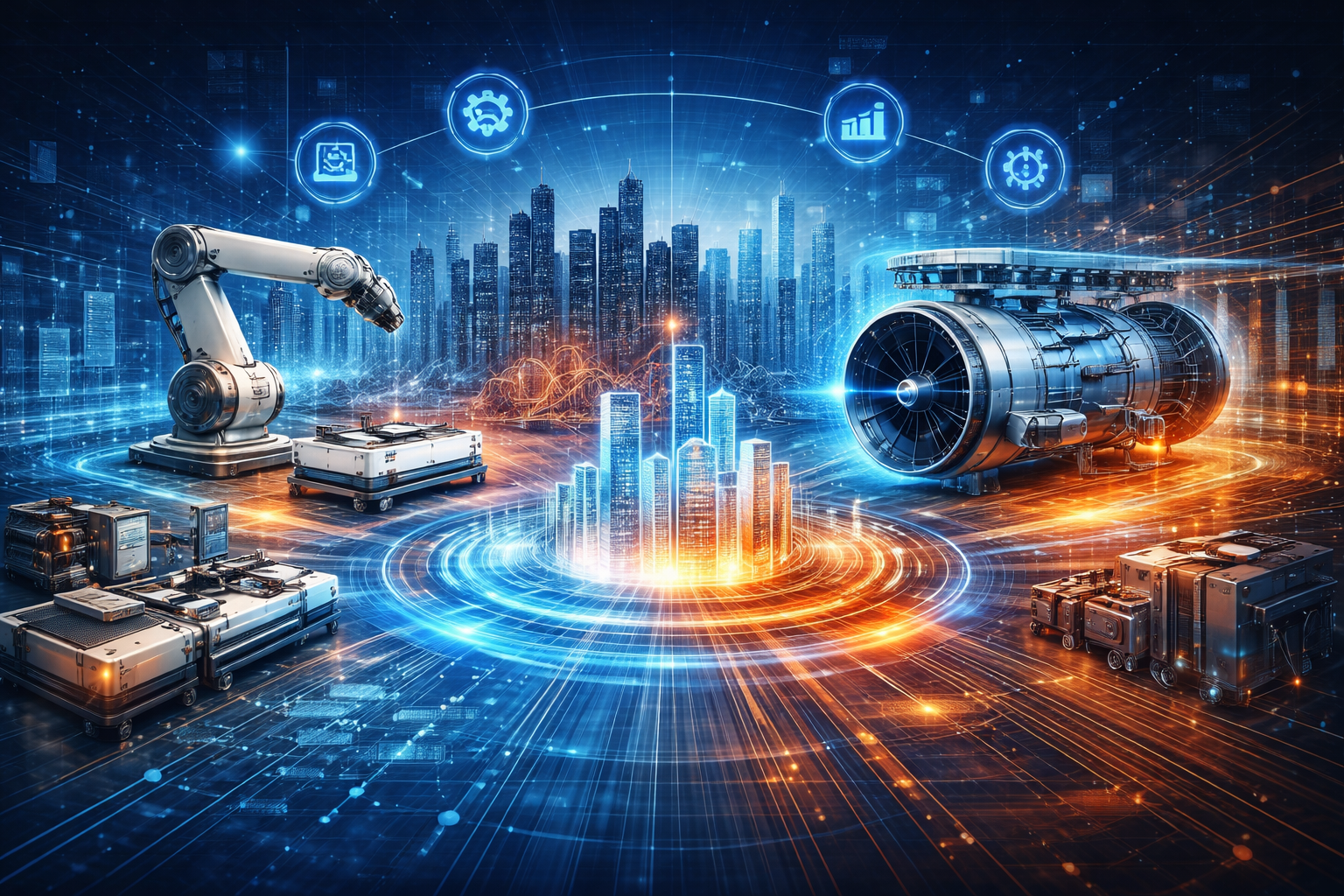
디지털 트윈과 기계공학 — “가상에서 기계를 다시 설계하는 시대”
디지털 트윈(Digital Twin)은 단순한 IT 기술이 아니다. 오히려 그 본질은 기계공학의 확장에 가깝다. 현실의 기계 시스템을 정확히 이해하고, 이를 디지털 공간에 복제하며, 나아가 미래 상태까지 예측하는 기술이기 때문이다.
이 글에서는 디지털 트윈과 기계공학이 어떻게 연결되는지, 그리고 왜 기계공학이 이 기술의 핵심인지 구조적으로 정리해본다.
1. 디지털 트윈의 본질: 물리를 이해해야 복제할 수 있다
디지털 트윈의 핵심은 단순한 3D 모델이 아니라, **“물리적으로 동작하는 가상 시스템”**이다.
즉,
- 현실: 힘, 열, 유동, 진동이 존재하는 물리 시스템
- 디지털 트윈: 이 물리 현상을 수식과 데이터로 재현한 시스템
결국 디지털 트윈은 다음과 같은 흐름으로 작동한다.
물리 법칙 → 수학적 모델 → 시뮬레이션 → 데이터 반영 → 예측
이 과정에서 출발점은 항상 기계공학적 이해다.
2. 기계공학 4대 영역과 디지털 트윈의 연결
① 동역학 & 진동 → 고장 예측
기계 시스템은 항상 움직이고, 진동하며, 마모된다.
- 베어링 진동 증가
- 모터 불균형
- 구조 피로 누적
이러한 요소를 기반으로 디지털 트윈은 고장 시점을 예측한다.
대표적으로 GE Aviation은 항공기 엔진의 진동 데이터를 분석해 정비 시점을 사전에 판단한다.
이는 전형적인 동역학 + 피로 해석 기반 접근이다.
② 열역학 → 시스템 효율 최적화
기계 시스템에서 열은 성능과 직결된다.
- 반도체 장비 온도 안정성
- 엔진 열효율
- 배터리 열관리
디지털 트윈은 열 흐름을 시뮬레이션하여:
- 과열 구간 제거
- 냉각 시스템 최적화
- 에너지 비용 절감
을 가능하게 한다.
예를 들어 Siemens은 공장 전체 에너지 흐름을 디지털 트윈으로 분석해 운영 효율을 크게 개선했다.
③ 유체역학(CFD) → 보이지 않는 흐름 제어
현실에서는 보이지 않지만, 성능을 좌우하는 요소가 바로 “유동”이다.
- 공기 흐름 (항공기, 클린룸)
- 가스 흐름 (반도체 공정)
- 냉각수 흐름
디지털 트윈은 CFD(전산유체역학)를 통해 이를 가상에서 재현한다.
이로 인해:
- 설계 변경 없이 성능 테스트 가능
- 수백 가지 조건을 빠르게 비교
즉, 실험의 비용과 시간을 획기적으로 줄인다
④ 기구학 & 제어 → 움직임 최적화
자동화 시스템에서 가장 중요한 것은 “움직임”이다.
- 로봇 팔
- AGV / OHT
- 자동화 설비
디지털 트윈에서는:
- 최적 경로 계산
- 충돌 방지
- 속도 및 가속 제어
가 가능하다.
이 영역은 기계공학 + 제어공학 + 알고리즘이 결합되는 지점이다.
3. 반도체 물류(OHT)에서의 실제 적용 가능성
반도체 공장의 OHT 시스템을 생각해보자.
기존 방식은 다음과 같다:
- 경험 기반 설계
- 룰 기반 제어
- 사후 대응 중심 운영
하지만 디지털 트윈을 적용하면 완전히 달라진다.
적용 요소
- 동역학 → OHT 가속/감속 모델
- 마찰 → 에너지 소비 분석
- 진동 → 레일 안정성 평가
- 위치 데이터 → 실시간 흐름 분석
가능해지는 것
- 병목 구간 사전 예측
- 충돌 위험 시뮬레이션
- 물류 흐름 최적화
- 설비 배치 자동 개선
즉,
“문제가 발생한 후 대응” → “문제가 생기기 전에 제거”
로 패러다임이 바뀐다.
4. 디지털 트윈이 바꾸는 설계 방식
기존 기계공학 프로세스:
설계 → 제작 → 테스트 → 수정
디지털 트윈 기반 프로세스:
설계 → 가상 테스트 수백~수천 회 → 최적 설계 → 제작
이 변화는 단순한 효율 개선이 아니라,
제품 개발 방식 자체를 바꾸는 혁신이다.
5. 기술 스택으로 본 구조
디지털 트윈은 다음과 같은 계층 구조를 가진다.
- 기계공학 (물리 모델)
- 수학 (미분방정식, 수치해석)
- 시뮬레이션 (FEM, CFD)
- 데이터 (센서, IoT)
- AI (예측, 최적화)
여기서 가장 중요한 것은 1번이다.
물리를 모르면, 디지털 트윈은 껍데기에 불과하다
6. 핵심 인사이트: 기계공학의 부활
디지털 트윈 시대에는 오히려 기계공학의 가치가 더 커진다.
단순히 코딩이나 AI만으로는 해결할 수 없는 이유는 명확하다:
- 현실은 물리 법칙을 따른다
- 데이터는 그 결과일 뿐이다
따라서 진짜 경쟁력은:
“물리 시스템을 이해하고, 그것을 디지털로 옮길 수 있는 능력”
이다.
결론
디지털 트윈과 기계공학의 관계는 다음 한 문장으로 정리된다.
기계공학이 현실을 이해하는 학문이라면,
디지털 트윈은 그 현실을 예측 가능한 시스템으로 만드는 기술이다.
그리고 이 둘이 결합될 때:
- 비용은 줄고
- 리스크는 낮아지며
- 설계는 더 빠르고 정확해진다
이제 기계는 단순한 구조물이 아니라,
데이터로 살아 움직이는 시스템이 된다.
Digital Twin & Mechanical Engineering — “Redesigning Machines in the Virtual World”
Digital Twin is not simply an IT technology.
At its core, it is much closer to an extension of mechanical engineering. It is a technology that accurately understands real-world mechanical systems, replicates them in a digital space, and even predicts their future behavior.
In this article, we will explore how digital twins are connected to mechanical engineering, and why mechanical engineering lies at the heart of this technology.
1. The Essence of Digital Twin: You Must Understand Physics to Replicate Reality
The core of a digital twin is not just a 3D model, but a “physically operating virtual system.”
In other words:
- Reality: A physical system governed by forces, heat, flow, and vibration
- Digital Twin: A system that reproduces these physical phenomena through equations and data
Ultimately, a digital twin operates through the following process:
Physical laws → Mathematical models → Simulation → Data integration → Prediction
The starting point of this entire process is always a deep understanding of mechanical engineering.
2. Four Core Areas of Mechanical Engineering in Digital Twins
① Dynamics & Vibration → Failure Prediction
Mechanical systems are always in motion, vibrating, and gradually wearing out.
- Bearing vibration increase
- Motor imbalance
- Structural fatigue accumulation
Digital twins use these signals to predict failure in advance.
For example, GE Aviation analyzes aircraft engine vibration data to determine maintenance timing proactively.
This is a classic approach based on dynamics and fatigue analysis.
② Thermodynamics → System Efficiency Optimization
Heat directly affects system performance.
- Semiconductor equipment temperature stability
- Engine thermal efficiency
- Battery thermal management
Digital twins simulate heat flow to:
- Eliminate overheating zones
- Optimize cooling systems
- Reduce energy costs
For instance, Siemens uses digital twins to analyze energy flow across entire factories, significantly improving operational efficiency.
③ Fluid Mechanics (CFD) → Controlling Invisible Flows
Flow is often invisible, but it critically impacts performance.
- Airflow (aircraft, cleanrooms)
- Gas flow (semiconductor processes)
- Cooling fluid flow
Digital twins leverage CFD (Computational Fluid Dynamics) to simulate these flows virtually.
This enables:
- Performance testing without physical redesign
- Rapid comparison of hundreds of scenarios
In other words, it dramatically reduces the cost and time of experimentation.
④ Kinematics & Control → Motion Optimization
In automation systems, movement is everything.
- Robotic arms
- AGV / OHT systems
- Automated equipment
Digital twins enable:
- Optimal path planning
- Collision avoidance
- Speed and acceleration control
This domain is where mechanical engineering, control engineering, and algorithms converge.
3. Practical Application in Semiconductor Logistics (OHT)
Let’s consider an OHT (Overhead Hoist Transport) system in a semiconductor fab.
Traditional approach:
- Experience-based design
- Rule-based control
- Reactive operation
With Digital Twin:
Applied elements:
- Dynamics → Acceleration/deceleration modeling
- Friction → Energy consumption analysis
- Vibration → Rail stability evaluation
- Position data → Real-time flow analysis
What becomes possible:
- Bottleneck prediction in advance
- Collision risk simulation
- Logistics flow optimization
- Automated layout improvement
In short:
“Reacting after problems occur” → “Eliminating problems before they happen”
4. How Digital Twins Transform Engineering Processes
Traditional mechanical engineering workflow:
Design → Build → Test → Modify
Digital twin-based workflow:
Design → Hundreds/thousands of virtual tests → Optimized design → Build
This is not just an efficiency improvement—
it is a fundamental transformation of how products are developed.
5. Technology Stack Perspective
A digital twin is built on the following layered structure:
- Mechanical Engineering (physical models)
- Mathematics (differential equations, numerical analysis)
- Simulation (FEM, CFD)
- Data (sensors, IoT)
- AI (prediction, optimization)
Among these, the most critical layer is the first.
Without understanding physics, a digital twin is just an empty shell.
6. Key Insight: The Revival of Mechanical Engineering
In the era of digital twins, the value of mechanical engineering is actually increasing.
Why?
Because:
- The real world follows physical laws
- Data is merely the result of those laws
Therefore, true competitiveness lies in:
“The ability to understand physical systems and translate them into digital models”
Conclusion
The relationship between digital twins and mechanical engineering can be summarized in one sentence:
If mechanical engineering is the discipline that understands reality,
digital twins are the technology that makes that reality predictable.
When these two are combined:
- Costs decrease
- Risks are reduced
- Design becomes faster and more accurate
Machines are no longer just physical structures.
They become living systems driven by data.
'T — Tech & Trends' 카테고리의 다른 글
| [digital twin-3] 디지털 트윈 시스템 구조 완전 해부: 센서부터 시뮬레이션까지 (0) | 2026.03.22 |
|---|---|
| [digital twin-2] 디지털 트윈은 어떻게 구현할까? 기계공학 필수 이론 총정리 (0) | 2026.03.21 |
| 🛡️ Why Defense Projects Are the Most Complex Engineering Programs (0) | 2026.03.16 |
| 세계의 인기 놀이기구와 최신 기술 소개 (Popular Rides and Advanced Technology) (3) | 2024.11.14 |
| 비트코인과 기계공학: The Technical Connection Between M.E. and the Coin Industry (0) | 2024.11.08 |


댓글