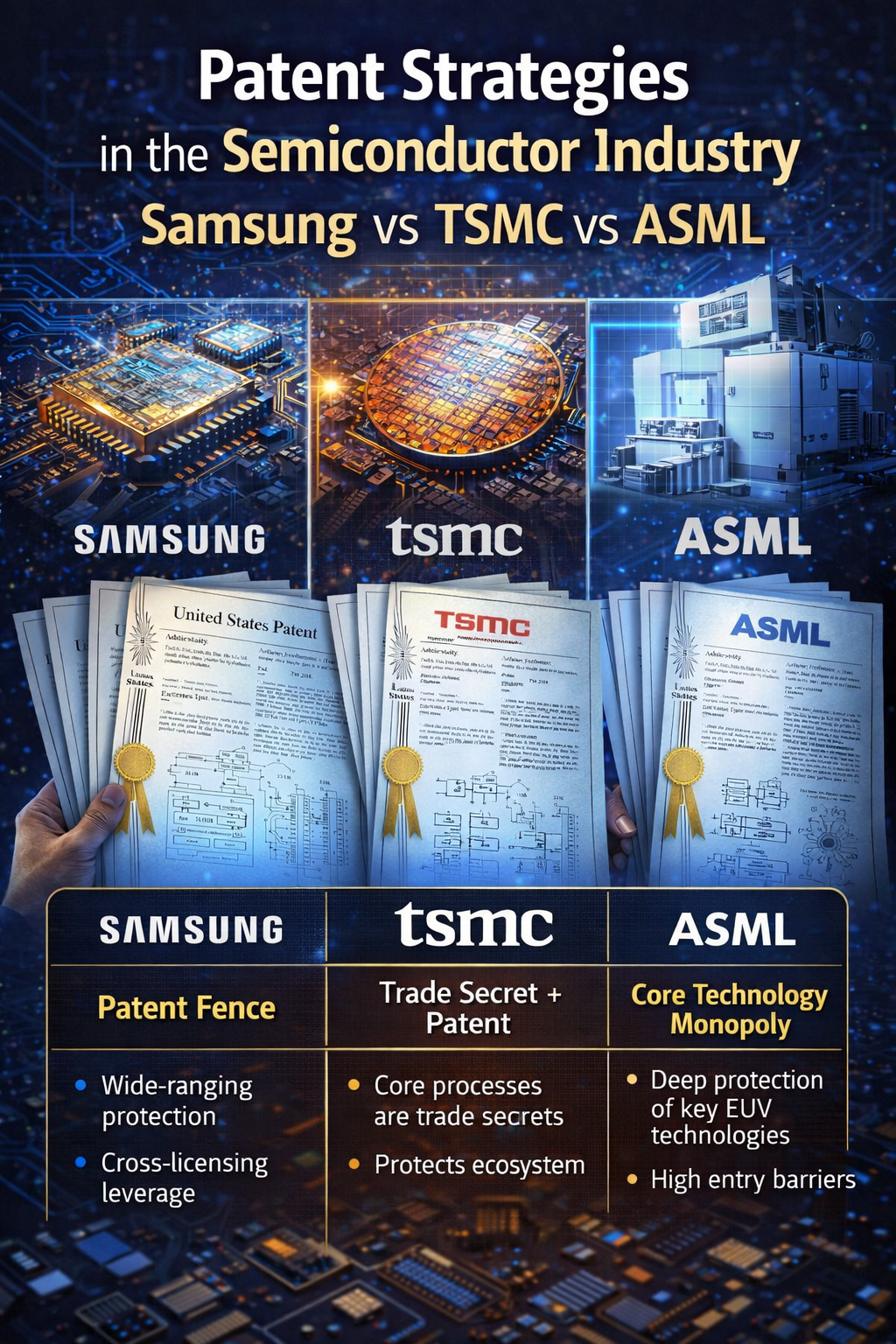
반도체 산업의 특허 전략
Samsung, TSMC, ASML이 기술 경쟁을 지배하는 방법
반도체 산업에서 기술 경쟁은 단순히 제품 성능 경쟁이 아닙니다.
그 이면에는 기업의 미래를 좌우하는 특허 전략(Patent Strategy) 이 존재합니다.
특허는 단순히 기술을 보호하는 법적 장치가 아니라,
시장 진입을 통제하고 산업 구조를 형성하는 전략적 도구입니다.
특히 반도체 산업에서는 기업의 사업 모델에 따라
완전히 다른 특허 전략이 나타납니다.
대표적인 사례가 바로
- Samsung Electronics
- TSMC
- ASML
이 세 기업입니다.
이들은 각각 완전히 다른 방식으로 특허를 활용하여 산업 경쟁력을 확보하고 있습니다.
1️⃣ Samsung: 기술 영역을 넓게 덮는 “Patent Fence 전략”
Samsung Electronics 의 핵심 전략은
대규모 특허 포트폴리오 구축을 통한 기술 영역 장악입니다.
삼성은 특정 핵심 기술 하나만 보호하는 것이 아니라
**그 기술 주변 영역까지 특허로 둘러싸는 “Patent Fence 전략”**을 적극적으로 활용합니다.
이 전략은 다음과 같은 특징을 가집니다.
① 광범위한 특허 포트폴리오 구축
삼성은 반도체 산업 전반에 걸쳐 대량의 특허를 확보하고 있습니다.
대표적인 분야는 다음과 같습니다.
- 메모리 반도체 구조 설계
- 반도체 패키징 기술
- 반도체 제조 공정 장비
- AI 반도체 아키텍처
- 고속 인터페이스 기술
이러한 광범위한 특허 확보는 단순한 기술 보호 목적이 아니라
기술 생태계 자체를 장악하기 위한 전략입니다.
② 경쟁사의 우회 설계를 어렵게 만드는 구조
Patent Fence 전략의 핵심은
경쟁사가 핵심 특허를 피해도 다른 특허에 걸리도록 만드는 것입니다.
예를 들어
- 메모리 셀 구조
- 인터커넥트 구조
- 패키징 방식
등의 기술을 다층적으로 특허화하면
경쟁사는
- 핵심 기술을 사용하기 어렵고
- 설계를 변경해도 다른 특허에 저촉될 가능성이 높습니다.
이러한 전략은 기술 장벽(Technology Barrier) 을 매우 높입니다.
③ Cross-License 협상력 강화
반도체 산업에서는 Cross License가 매우 중요합니다.
즉,
기업 A: “내 특허를 사용하려면 당신 특허도 공유하자.”
이런 협상이 이루어집니다.
삼성처럼 대규모 특허 포트폴리오를 가진 기업은 협상에서 매우 유리한 위치를 차지합니다.
결과적으로
- 기술 사용료 절감
- 경쟁사 견제
- 기술 협력 확대
라는 효과를 동시에 얻을 수 있습니다.
📌 전략적 의미
Patent Fence 전략은
**“기술 하나가 아니라 기술 영역 전체를 보호하는 전략”**입니다.
따라서 경쟁사는
핵심 특허를 피해도 주변 특허에 막히는 구조가 됩니다.
2️⃣ TSMC: 공정 기술 중심의 “Trade Secret + Patent 전략”
TSMC 의 전략은 삼성과 상당히 다릅니다.
TSMC는 세계 최대 파운드리 기업으로
핵심 경쟁력이 공정 기술(Process Technology) 에 있습니다.
하지만 공정 기술은 특허로 보호하기 어려운 특성을 가지고 있습니다.
그래서 TSMC는
특허 + 영업비밀(Trade Secret) 을 결합한 전략을 사용합니다.
① 핵심 공정 기술은 Trade Secret으로 보호
반도체 제조 공정의 핵심은 다음과 같은 요소들입니다.
- 공정 레시피(Process Recipe)
- 장비 세팅(Tool Tuning)
- 공정 파라미터(Process Parameter)
- 공정 통합(Process Integration)
이러한 요소들은 특허로 공개하면
경쟁사가 기술을 분석할 수 있는 위험이 있습니다.
따라서 TSMC는
핵심 공정 기술을 특허로 공개하지 않고 내부 노하우로 관리합니다.
② 특허는 공정 생태계를 보호하는 용도
TSMC도 특허를 많이 보유하고 있지만
그 목적은 삼성과 조금 다릅니다.
TSMC 특허는 주로 다음 영역에 집중됩니다.
- 공정 장비 인터페이스
- 제조 자동화 시스템
- 패키징 기술
- 칩 설계 지원 기술
즉,
공정 생태계를 보호하는 특허입니다.
③ 기술 공개 여부를 전략적으로 선택
TSMC의 기술 관리 전략은 매우 명확합니다.
| 핵심 공정 | Trade Secret |
| 생태계 기술 | Patent |
이 전략의 장점은
- 기술 공개를 최소화
- 경쟁사의 기술 추격 방지
- 장기적 기술 격차 유지
입니다.
📌 전략적 의미
TSMC의 전략은
“기술을 공개하지 않으면서 경쟁력을 유지하는 전략”
입니다.
3️⃣ ASML: 핵심 기술 독점 전략
EUV 노광 장비 시장을 사실상 독점하고 있는
ASML 의 전략은 더욱 독특합니다.
ASML은
특정 핵심 기술을 완전히 장악하는 특허 전략을 사용합니다.
① 핵심 기술에 특허를 집중
ASML은 다음 기술 분야에서 매우 강력한 특허 포트폴리오를 구축했습니다.
- EUV 광원(Light Source)
- 초정밀 광학 시스템
- 웨이퍼 스테이지 제어
- 마스크 및 레티클 시스템
- 진공 환경 제어
EUV 장비는 수많은 기술의 결합으로 이루어지지만
ASML은 각 핵심 기술에 대해 매우 강력한 특허 장벽을 구축했습니다.
② 장비 생태계 전체를 보호
ASML 특허의 특징은
단일 장비가 아니라 장비 생태계 전체를 보호한다는 점입니다.
예를 들어
- 노광 장비
- 마스크 기술
- 광학 시스템
- 공정 인터페이스
등이 서로 연결된 특허 구조를 형성합니다.
이러한 구조는 경쟁사가 부분적으로 기술을 개발해도 시장 진입이 어렵게 만드는 효과를 냅니다.
③ 기술적 진입장벽 구축
현재 EUV 장비 시장은 사실상 ASML 독점 구조입니다.
이 구조를 만든 핵심 요소는
- 기술 난이도
- 공급망 협력
- 특허 장벽
입니다.
특히 특허 장벽은 경쟁사가 EUV 기술을 개발하더라도
상용화 단계에서 큰 장애물이 됩니다.
📌 전략적 의미
ASML 전략의 핵심은
특정 기술 영역을 완전히 장악하여 시장 진입 자체를 차단하는 것
입니다.
4️⃣ 세 기업의 특허 전략 비교
| Samsung | Patent Fence | 기술 영역을 넓게 보호 |
| TSMC | Trade Secret + Patent | 핵심 기술은 비공개 |
| ASML | Core Technology Monopoly | 특정 기술을 완전히 장악 |
5️⃣ 엔지니어 관점에서 가장 흥미로운 포인트
특허 전략은 단순한 법적 전략이 아니라
기업의 사업 모델과 직접적으로 연결됩니다.
일반적으로 다음과 같은 패턴이 나타납니다.
| 제품 기업 | 대규모 특허 포트폴리오 |
| 공정 기업 | 노하우 중심 전략 |
| 장비 기업 | 핵심 기술 독점 |
그래서 특허를 분석하면
그 회사의 기술 전략과 사업 전략이 동시에 보입니다.
💡 많은 전문가들이
반도체 산업에서 가장 강력한 특허 전략을 가진 기업으로
ASML 을 꼽는 이유도 여기에 있습니다.
EUV 시장은 사실상
“특허로 만들어진 독점 시장”
이라고 볼 수 있기 때문입니다.
Patent Strategies in the Semiconductor Industry
How Samsung, TSMC, and ASML Dominate Technological Competition
In the semiconductor industry, technological competition is not simply about product performance.
Behind the scenes, companies compete through carefully designed patent strategies that shape the structure of the entire industry.
Patents are not merely legal tools for protecting inventions.
They function as strategic assets that control market entry, influence industry ecosystems, and secure long-term technological leadership.
Three companies represent three fundamentally different approaches to patent strategy:
- Samsung Electronics
- TSMC
- ASML
Each company leverages intellectual property in a distinct way to maintain its competitive advantage.
1️⃣ Samsung: The “Patent Fence” Strategy
The core strategy of Samsung Electronics is the creation of a large and diversified patent portfolio.
Rather than protecting only a single core technology, Samsung actively builds a “Patent Fence” around key innovations.
This means surrounding the core technology with numerous related patents to prevent competitors from easily designing around it.
Broad Patent Portfolio
Samsung secures patents across a wide range of semiconductor technologies, including:
- Memory architecture and cell design
- Advanced semiconductor packaging
- Semiconductor manufacturing equipment
- AI accelerator architectures
- High-speed interface technologies
This extensive portfolio is not simply for defensive protection.
It is intended to control technological territory across the semiconductor ecosystem.
Limiting Competitor Design-Around
The strength of a Patent Fence strategy lies in its ability to block alternative design paths.
For example, Samsung may patent multiple variations of:
- memory cell structures
- interconnect configurations
- packaging integration techniques
Even if a competitor attempts to avoid one patent, it may still infringe on another related patent within the surrounding fence.
As a result, the technological barrier becomes significantly higher.
Strengthening Cross-Licensing Power
In the semiconductor industry, cross-licensing agreements are common.
For example:
Company A allows Company B to use its patents in exchange for access to Company B’s patents.
Companies with large patent portfolios—such as Samsung—hold significant negotiating leverage in these agreements.
This provides several strategic advantages:
- reduced royalty costs
- increased technological collaboration
- stronger defensive positioning against competitors
📌 Strategic implication
The Patent Fence strategy protects not just a single invention but an entire technological domain.
Even if competitors avoid the core patent, they are often blocked by surrounding patents.
2️⃣ TSMC: A Hybrid Strategy of Trade Secrets and Patents
The strategy of TSMC is fundamentally different.
As the world’s leading semiconductor foundry, TSMC’s core strength lies in manufacturing process technology.
However, process technology has characteristics that make patent protection less effective.
As a result, TSMC relies on a hybrid strategy combining trade secrets and patents.
Protecting Core Processes as Trade Secrets
The most critical aspects of semiconductor manufacturing include:
- process recipes
- equipment tuning parameters
- process integration methods
- yield optimization techniques
If these were disclosed through patents, competitors could analyze and replicate the technology.
Therefore, TSMC keeps many of these core technologies strictly confidential as trade secrets.
Using Patents to Protect the Manufacturing Ecosystem
TSMC still holds a large number of patents, but their role is slightly different.
These patents often focus on areas such as:
- manufacturing automation systems
- equipment interface technologies
- advanced packaging techniques
- design-for-manufacturing technologies
In other words, TSMC uses patents primarily to protect the surrounding manufacturing ecosystem.
Strategic Disclosure Management
TSMC carefully determines which technologies should be patented and which should remain secret.
| Core process know-how | Trade Secret |
| Supporting technologies | Patent |
This approach provides several advantages:
- minimal disclosure of critical knowledge
- reduced risk of technological imitation
- sustained long-term process leadership
📌 Strategic implication
TSMC’s approach allows the company to
maintain technological leadership without revealing its most valuable knowledge.
3️⃣ ASML: Core Technology Monopoly Strategy
The strategy of ASML is perhaps the most unique.
ASML has achieved near-complete dominance in the EUV lithography equipment market, and its patent strategy plays a major role in this position.
Rather than spreading patents broadly, ASML focuses on deep protection of critical core technologies.
Concentrated Patents in Key Technologies
ASML holds extremely strong patent positions in several crucial EUV subsystems, including:
- EUV light source technology
- ultra-precision optical systems
- wafer stage positioning systems
- mask and reticle handling systems
- vacuum and contamination control systems
EUV lithography systems are composed of numerous complex subsystems, and ASML has secured patents across these essential components.
Protecting the Entire Equipment Ecosystem
One unique aspect of ASML’s patent portfolio is that it protects the entire lithography ecosystem, not just individual components.
This includes:
- lithography hardware
- optical modules
- mask technologies
- system integration methods
Even if a competitor develops part of the technology, entering the market becomes extremely difficult due to the interconnected patent structure.
Creating an Extremely High Entry Barrier
Today, the EUV lithography market is effectively dominated by ASML.
This dominance is supported by three major factors:
- extreme technological complexity
- deep supply-chain collaboration
- strong intellectual property barriers
Even if competitors attempt to develop similar technologies, the patent landscape presents a significant obstacle to commercialization.
📌 Strategic implication
ASML’s approach focuses on
securing complete control over a critical technological domain.
4️⃣ Comparing the Three Patent Strategies
| Samsung | Patent Fence | Broad protection across technological domains |
| TSMC | Trade Secret + Patent | Core technologies remain undisclosed |
| ASML | Core Technology Monopoly | Deep protection of critical technologies |
5️⃣ An Interesting Insight from an Engineering Perspective
Patent strategies are closely linked to a company’s business model.
A common pattern can be observed:
| Product manufacturers | Large patent portfolios |
| Process technology leaders | Trade secret-focused protection |
| Equipment suppliers | Deep protection of core technologies |
By analyzing patents, it is often possible to understand both the technological direction and the business strategy of a company.
Many industry experts believe that ASML possesses one of the most powerful patent strategies in the semiconductor industry.
The EUV lithography market is, in many ways,
a monopoly built not only on technology but also on patents.
'C — Chip & Semiconductor' 카테고리의 다른 글
| HBM 시대, 반도체 물류자동화의 승자는 누구인가? (0) | 2026.03.27 |
|---|---|
| 📊 반도체 물류자동화 Top 10 (AMHS 기준) (0) | 2026.03.27 |
| 반도체 물류자동화 기업 Top 10 - 특허: 기술을 보호하는 힘 (0) | 2026.03.10 |
| 반도체 물류자동화 기업 Top 10 - 경쟁 그리고 미래 (0) | 2026.03.10 |
| HBF? (0) | 2026.03.06 |


댓글