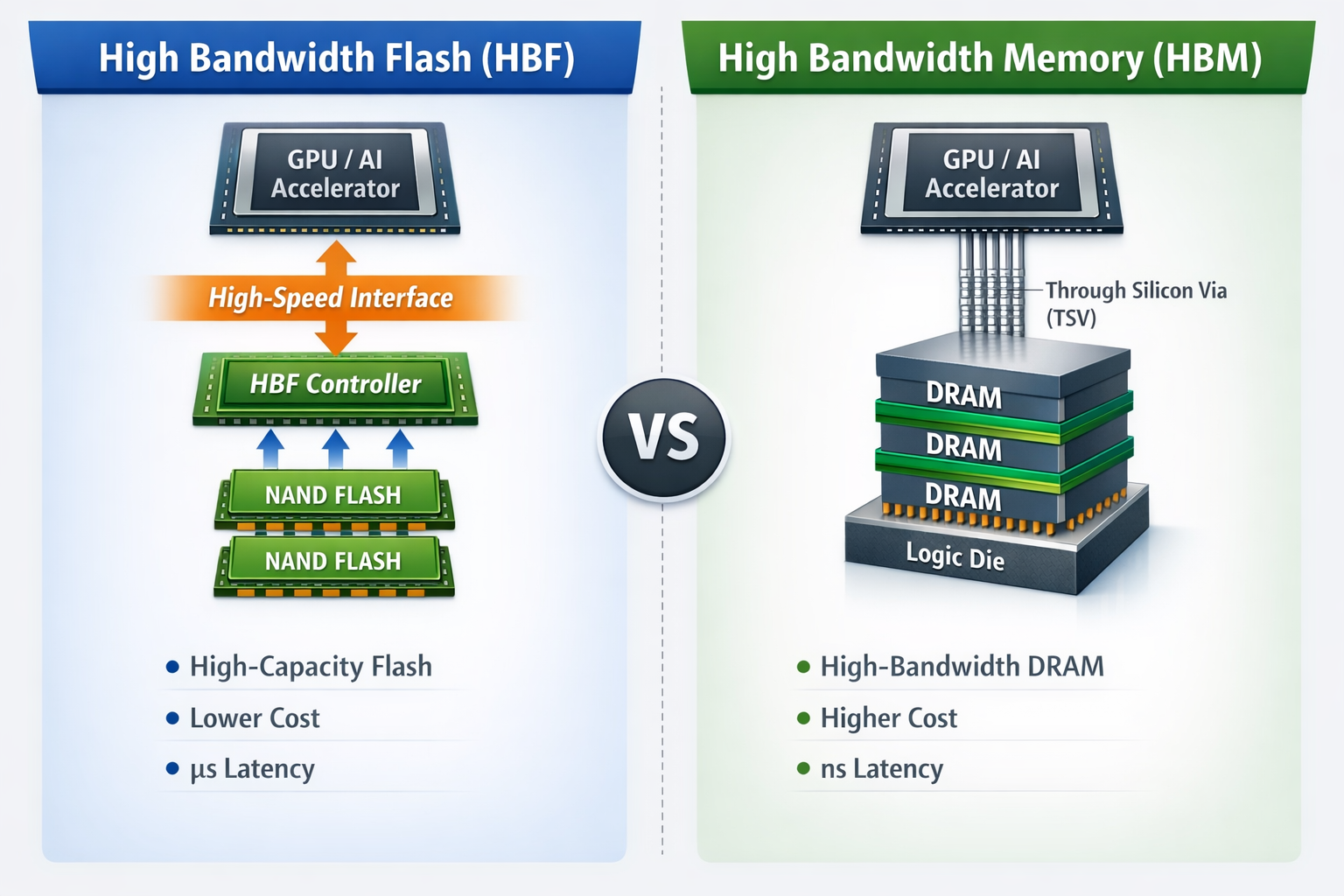
**HBF (High Bandwidth Flash)**는 말 그대로 고대역폭을 목표로 설계된 플래시 메모리 아키텍처를 의미합니다. 아직 JEDEC 같은 표준기구에서 공식 규격으로 확정된 메모리 표준은 아니고, 업계나 연구에서 AI/HPC용 고속 스토리지-메모리 중간 계층을 설명할 때 사용되는 개념적 용어입니다.
핵심 아이디어는 NAND Flash의 용량 장점 + HBM 수준의 인터페이스 대역폭을 결합하는 것입니다.
1. HBF (High Bandwidth Flash) 개념
HBF = NAND Flash 기반이지만 인터페이스 대역폭을 크게 높인 메모리
일반 SSD는 구조가 다음과 같습니다.
│
PCIe
│
SSD Controller
│
NAND Flash
이 구조의 한계는
- PCIe 인터페이스 병목
- 높은 latency
- DRAM 대비 낮은 대역폭
입니다.
그래서 제안된 구조가 HBF입니다.
│
High-speed interface
│
HBF controller
│
NAND Flash array
특징
- Flash 기반 (대용량)
- HBM보다 낮은 비용
- SSD보다 높은 대역폭
즉,
DRAM과 SSD 사이의 메모리 계층
입니다.
2. HBM (High Bandwidth Memory)
HBM (High Bandwidth Memory) 은 3D 적층 DRAM 메모리입니다.
구조
│
DRAM
DRAM
DRAM
DRAM
특징
- TSV(Through Silicon Via)
- 인터포저 기반 패키징
- 초광폭 I/O
대표 적용
- NVIDIA AI GPU
- AMD Instinct GPU
- Intel HPC accelerator
대역폭
| HBM2 | ~256 GB/s |
| HBM3 | ~819 GB/s |
| HBM3E | ~1 TB/s |
3. HBF vs HBM 구조 비교
| 메모리 타입 | NAND Flash | DRAM |
| 용도 | 고속 스토리지 | 초고속 메모리 |
| 대역폭 | SSD보다 높음 | 매우 높음 |
| 지연시간 | DRAM보다 느림 | 매우 낮음 |
| 용량 | 매우 큼 | 제한적 |
| 가격 | 상대적으로 저렴 | 매우 비쌈 |
4. 성능 비교 (개념적)
| Latency | ~100 ns | 수 µs | 수십 µs |
| Bandwidth | 1 TB/s | 수십~수백 GB/s | 수 GB/s |
| Capacity | 수십~수백 GB | TB급 | TB~PB |
그래서 AI 시스템에서 메모리 계층은 다음과 같이 구상됩니다.
│
HBM (compute memory)
│
HBF (capacity layer)
│
SSD / Storage
5. 왜 HBF가 필요해졌나 (AI 시대)
최근 AI 모델은 메모리 요구량이 급격히 증가했습니다.
예
- GPT 계열 모델
- 대형 diffusion 모델
문제
- GPU HBM 용량: 보통 80~192GB
- AI 모델: 수백 GB ~ TB
그래서 필요한 것이
대용량 + 고속 메모리
즉
HBM만으로 부족 → Flash를 빠르게 사용
이 개념이 HBF입니다.
6. 관련 기술 트렌드
이 분야 연구는 다음 기술들과 연결됩니다.
① Computational Storage
스토리지에서 일부 연산 수행
대표 기업
- Samsung Electronics
- Kioxia
② CXL Memory Expansion
Compute Express Link (CXL) 기반 메모리 확장
│
CXL
│
Flash / DRAM pool
③ AI Storage Acceleration
AI 학습 데이터를 빠르게 공급하는 스토리지
대표 기업
- Micron Technology
- SK hynix
7. 한 문장 정리
- HBM → AI 연산용 초고속 DRAM
- HBF → AI 데이터용 고속 Flash 메모리 계층
즉
HBM = 속도 중심
HBF = 용량 + 속도 균형
입니다.
--------------------------------
Exploring HBF (High Bandwidth Flash): The Next Frontier in AI Memory Hierarchy
1. What is HBF (High Bandwidth Flash)?
CPU / GPU ↔ PCIe Interface ↔ SSD Controller ↔ NAND Flash
- PCIe Interface Congestion: Limited by the number of lanes and generation.
- High Latency: Significant delays compared to volatile memory.
- Low Bandwidth: Far inferior to DRAM-based solutions.
GPU / AI Accelerator ↔ High-speed Interface ↔ HBF Controller ↔ NAND Flash Array
- Flash-Based: Offers massive capacity (Terabytes).
- Cost-Efficient: Lower cost per GB compared to HBM.
- High Throughput: Much faster bandwidth than standard SSDs.
- The "Middle Child": Acts as a critical memory tier between DRAM and SSD.
2. What is HBM (High Bandwidth Memory)?
- Structure: Logic Die ↔ Stacked DRAM layers connected via TSV (Through Silicon Via).
- Key Tech: Interposer-based packaging and ultra-wide I/O.
- Main Applications: NVIDIA AI GPUs (H100/B200), AMD Instinct GPUs, and Intel HPC Accelerators.
GenerationBandwidth (approx.)
| HBM2 | ~256 GB/s |
| HBM3 | ~819 GB/s |
| HBM3E | ~1 TB/s+ |
3. Structural Comparison: HBF vs. HBM
CategoryHBF (High Bandwidth Flash)HBM (High Bandwidth Memory)
| Memory Type | NAND Flash | DRAM |
| Primary Use | High-speed Storage Layer | Ultra-high-speed Compute Memory |
| Bandwidth | Higher than SSD | Extremely High |
| Latency | Slower than DRAM | Ultra-low |
| Capacity | Very Large (TB range) | Limited (GB range) |
| Cost | Relatively Affordable | Extremely Expensive |
4. Conceptual Performance Mapping
ItemHBMHBFStandard SSD
| Latency | ~100 ns | A few µs | Dozens of µs |
| Bandwidth | ~1 TB/s | Dozens to Hundreds of GB/s | A few GB/s |
| Capacity | Dozens/Hundreds of GB | TB Class | TB to PB Class |
GPU ➔ HBM (Compute Memory) ➔ HBF (Capacity Layer) ➔ SSD/Storage
5. Why HBF is Essential for the AI Era
- The Problem: While top-tier GPUs offer 80GB to 192GB of HBM, many AI models require several hundred GBs to Terabytes to run efficiently.
- The Solution: Since HBM is too expensive to scale to TB levels, we need a way to use Flash memory at high speeds. This is where HBF fills the gap—providing the capacity of Flash with the speed necessary for AI workloads.
6. Related Technological Trends
- Computational Storage: Performing partial calculations directly within the storage device (pioneered by Samsung Electronics and Kioxia).
- CXL Memory Expansion: Utilizing Compute Express Link (CXL) to create pools of Flash/DRAM that can be shared across CPUs and GPUs.
- AI Storage Acceleration: Developing storage that can feed training data to GPUs at lightning speeds (led by Micron Technology and SK hynix).
7. Summary in One Sentence
"HBM is the ultra-fast DRAM for AI computation, while HBF is the high-speed Flash layer for AI data capacity."
- HBM = Focus on Speed
- HBF = Balance of Capacity + Speed
'C — Chip & Semiconductor' 카테고리의 다른 글
| 반도체 물류자동화 기업 Top 10 - 특허: 기술을 보호하는 힘 (0) | 2026.03.10 |
|---|---|
| 반도체 물류자동화 기업 Top 10 - 경쟁 그리고 미래 (0) | 2026.03.10 |
| OHT는 왜 항상 부족할까 (0) | 2026.03.05 |
| HBM 전용 Fab, OHT-AMR 하이브리드 설계 모델 제안 (0) | 2026.03.04 |
| 반도체 Fab에서는 왜 아직 AMR이 주류가 되지 못할까? (0) | 2026.03.03 |


댓글